
For the first time, you can build production-grade AI apps, agents, research tools, automations, and even mini SaaS products without writing a single line of code.
This article is designed for tech users, developers, and AI enthusiasts who want to build intelligent systems without traditional programming, but still want:
- Deep technical understanding
- Real AI architecture knowledge
- Workflow clarity
- Agent-level insights
- RAG (Retrieval-Augmented Generation) fundamentals
- Deployment-ready guidance
If you’ve ever thought that “no-code AI” is only for beginners, 2026 proves otherwise.
It is now a power tool for developers, enabling rapid prototyping, faster iteration, automation, and full-scale deployment — without touching Python or JavaScript.
Let’s break it down the Technopedia way— deeply, clearly, and with insights competitors don’t offer.

Published Date:
Modify Date:
Disclosure: Technopedia.org.in is reader-supported. We may earn a small commission when you purchase through our affiliate links (Amazon) at no extra cost to you. Prices are accurate as of November 2025.
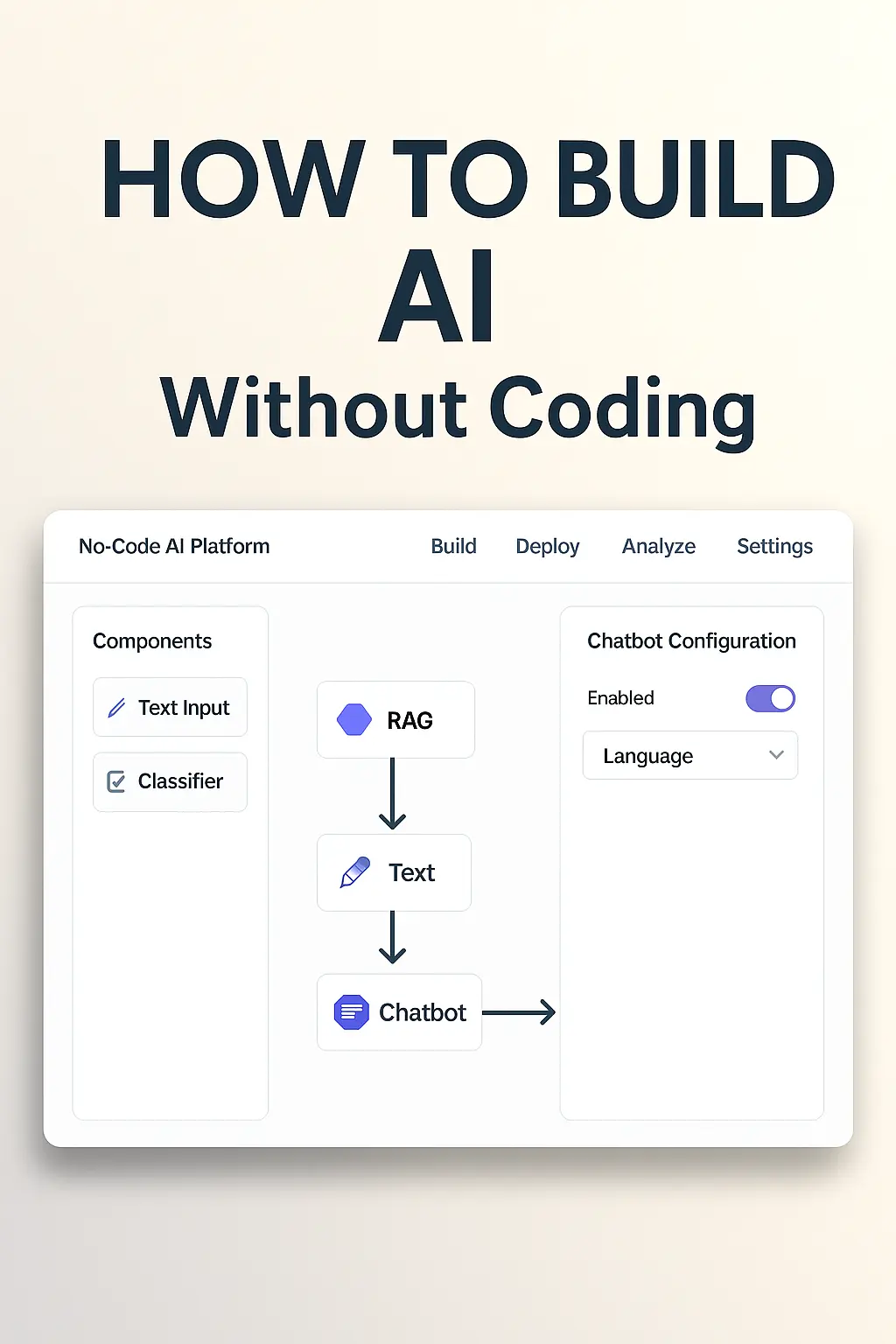
Table of Contents
Why Building AI Without Coding Is Possible in 2025
Until recently, creating AI required:
- Python
- LangChain
- Vector databases
- Model fine-tuning
- Docker
- APIs
- Frontend code
- Backend servers
Now, modern no-code AI builders abstract all this into:
- Visual workflows
- Pre-built logic blocks
- Automatic RAG pipelines
- Drag-and-drop tools
- Auto-embedding vector stores
- Visual agent behavior editors
- One-click inference hosting
- No-code API connectors
Think of it as “AI engineering with UI instead of code.”
And the results are surprisingly powerful — many startups today are shipping full AI SaaS applications without writing code at all.
Free Artificial Intelligence Crash Course:
Also Read: OpenAI Mixpanel Data Exposure Explained; The Real Incident, What Was Exposed, and What Users Should Know
The Core Building Blocks of No-Code AI (2026 Edition)
To build meaningful AI systems in 2026, you need to understand these pillars.
1. Powerful No-Code AI Engines (LLMs + Memory)
Modern no-code AI builders now integrate top-tier models:
- OpenAI GPT-5
- Claude 3.7
- Gemini 2.0 Ultra
- Llama 3.2 (hosted)
- Mistral Large
These engines come with:
- Built-in memory
- Structured outputs
- Function calling
- Tool execution
- Vision + text integration
- Real-time reasoning
Meaning you can build tools that behave like custom GPTs — without any programming.
2. No-Code RAG (Retrieval-Augmented Generation)
One of the most important breakthroughs.
AI becomes smarter when it can reference:
- PDFs
- Research
- Company data
- Docs & manuals
- Websites
- Knowledge bases
Modern no-code tools let you:
- Upload documents
- Auto-chunk them
- Auto-embed them
- Store vectors
- Build full retrievers
- Add citations
- Add scoring rules
This means you can build a domain-specific AI in minutes.
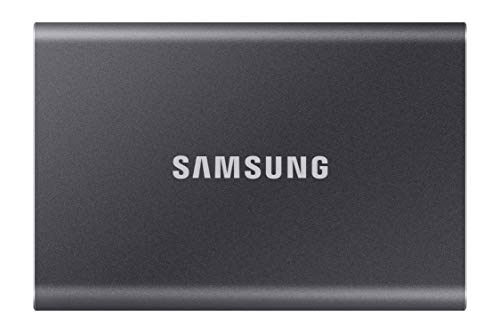
External SSDs (For datasets, documents, PDFs, knowledge bases):


Also Read: OpenAI Debuts ChatGPT Shopping Research Tool (2025): Deep Analysis, Insider Breakdown & The Future of AI-Powered Buying Decisions
3. No-Code Multi-Agent Systems
In 2025, agents are mainstream.
Agents can:
- Plan
- Reason
- Delegate
- Use tools
- Trigger workflows
- Analyze context
- Access external APIs
- Validate outputs
And no-code platforms let you build multi-agent systems with visual orchestration, where you define:
- Agent roles
- Goals
- Policies
- Capabilities
- Tools
- Memory rules
This is the kind of architecture used in AI-powered research teams or automated customer support systems.
4. No-Code Vector Databases
Traditionally, developers used:
- Pinecone
- Weaviate
- Milvus
- Chroma
Now, modern no-code AI systems include:
- Built-in vector DB
- Auto-indexing
- Auto-schema
- Auto-embeddings
You upload documents — the system does the rest.
5. No-Code API & Tool Integration
This is where things get powerful.
You can connect:
- Google Search
- Slack
- Webhooks
- Internal APIs
- Payment systems
- CRMs
- Knowledge services
- Automation apps
No coding required.
Tools appear in your agent as function calls.
This is the secret behind building full AI tools.
These are the Best-Selling Productivity Tools for AI builders must have, according to Technopedia’s research:






Also Read: Nano Banana Pro Review 2025: Google’s New AI Image Model Is Changing Everything for Indian Creators
How to Build AI Without Coding: Step-by-Step Framework
Now we go deep — this is the full architecture developers follow when building no-code AI apps.
Step 1: Choose Your No-Code AI Builder
Popular platforms for dev-level no-code AI:
- OpenAI Assistants Builder
- Flowise
- Zapier AI Suite
- Relevance AI
- Lobe AI
- Bubble + AI Plugins
- Make.com Workflows
- Voiceflow (for conversational apps)
These platforms handle all backend complexity.
Choose one based on:
- App type
- Data types
- Agent complexity
- API integration needs
- Deployment format
Step 2: Define the AI Behavior (System Instructions)
Instead of writing code, you define:
- Role
- Personality
- Output structure
- Reasoning mode
- Safety rules
- Memory usage
- Allowed tools
- Constraints
- Planning style
This acts as your “backend logic.”
Well-crafted system instructions are more important than developers think.
Step 3: Add Tools and APIs
Your AI must be able to interact with the real world.
You can integrate:
Built-In Tools
- Browsing
- File editing
- Document reading
- Email sending
- Data extraction
External APIs
- Stripe
- Zapier
- Slack
- Notion
- Custom APIs
You can describe an API in plain English — the tool auto-generates the function schema.
Step 4: Add Custom Knowledge (RAG)
Upload:
- PDFs
- Spreadsheets
- Knowledge bases
- Research
- Manuals
- Company documents
The system auto-creates:
- Embeddings
- Chunking
- Vector store
- Retrieval policies
This makes your AI “domain-specialized.”
Step 5: Build the Logic Flow (Visual Programming)
This is where no-code shines.
You visually design workflows using nodes like:
- If/else
- Retrieval block
- Memory block
- Tool execution
- Agent collaboration
- Human approval steps
- Looping
- API call
- Output format
- Error handling
This replaces writing backend code.
Step 6: Deploy the AI App
Deployment options include:
Web apps
Embed your AI directly in your website.
Internal tools
For business process automation.
Chat assistants
For customer support or operations.
Multi-agent dashboards
For research, data processing, or workflow automation.
Mobile apps
Using wrappers or no-code mobile app builders.
Everything is hosted automatically — no servers, no DevOps.
Real AI Builds You Can Create Without Coding
You can build incredibly powerful systems:
- AI customer support
- Research assistants
- Multi-agent work automation
- Data extraction bots
- Slack/WhatsApp AI agents
- Business workflow automation
- Legal document analyzers
- Coding assistants
- Personal analyst agents
- Scheduling & productivity bots
- Internal knowledge chatbots
- AI-powered dashboards
According to MIT Technology Review, 2025 is the “breakout year” for agent-based systems built without traditional coding.
Advanced No-Code Concepts (For Developers)
Multi-Agent Orchestration
You can build groups of agents with:
- Shared memory
- Task delegation
- Planning
- Role hierarchy
- Workflow stages
- Quality checks
This mimics real human teams.
No-Code Fine-Tuning
Upload examples and the system handles:
- Tokenization
- LR scheduling
- Checkpointing
- Training
- Deployment
Fine-tuning is now point-and-click.
Observability Without Coding
Track:
- Latency
- Token usage
- Errors
- Model decisions
- Tool calls
- Failure modes
All via dashboards — no scripts.
Have a Look at Our Top Picks: Smart Speakers & IoT Devices



FAQs
Can I build AI tools without coding?
Yes. In 2026, no-code platforms will allow agent creation, app hosting, automation, and RAG without coding.
Do I need programming experience?
No, but tech understanding helps.
Are no-code AI tools production-ready?
Yes — many successful SaaS products run fully on no-code AI.
What can I build?
Bots, agents, knowledge apps, workflow tools, dashboards, automation systems, and more.
5. Is it secure?
Reputable no-code platforms provide enterprise security.
Final Verdict
2025 is the year when developers, tech users, and AI enthusiasts can build powerful AI systems without writing code. From agents to RAG to multi-step workflows, modern no-code platforms abstract away complexity and let you focus on logic, not syntax.
You can now build AI faster, deploy it easier, and scale it instantly — all without touching backend code.
The no-code AI revolution isn’t coming.
It’s already here.
Loved this guide? Explore more in Cybersecurity, AI Trends, Buying Guides, and Tech Review — your next tech discovery starts here. Don’t miss any Trending Tech News.






Leave a Reply